Paper introduction · IJIET · 2026

A VR-Based Method for Observing Caregiver Intervention Timing under Standardized Childcare Conflict Scenes

Shigeru Owada, Kokone Sato, Shunsuke Kikuchi, Hidenori Aoki, Momoko Nakatani, Yuki Taoka, Tetsuhito Sakata, Midori Takahashi, Mikako Ishibashi
Sony Computer Science Laboratories · Institute of Science Tokyo · Otsuma Women's University · Gakushuin University · Edogawa University
VR Childcare quality Intervention timing ECEC Exploratory study
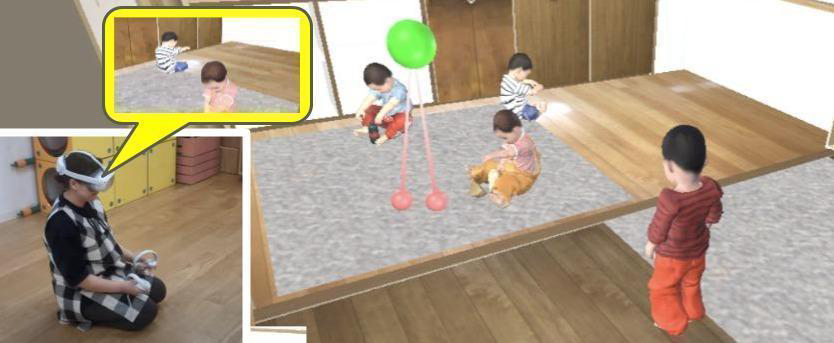
Overview of the intervention experiment in the virtual nursery
Fig. 1 — A caregiver intervening in a peer-conflict scene inside the virtual nursery, used to explore how intervention timing relates to pre-experiment profiling.
01 · Overview

When a caregiver intervenes in children's peer conflicts is a professional judgment that shapes the quality of early childhood education and care. Yet real childcare settings are highly context-dependent and hard to reproduce, making it difficult to compare caregivers under identical conditions. This study proposes a new methodological framework: a virtual nursery in VR that presents standardized conflict scenes and observes caregiver intervention timing objectively and quantitatively.

Background
"When to intervene" is unexplored
Prior research has focused on how caregivers intervene; the timing of intervention remained methodologically inaccessible. Questionnaires and field observation cannot compare caregivers under standardized conditions.
Proposal
Standardized observation in a virtual nursery
Caregivers wearing an HMD experience conflict scenes among one-year-olds in a virtual nursery. Touching a child is recorded as the intervention, and identical scenes for all participants make time-to-intervention directly comparable.
Key findings
Links to beliefs and stress
Intervention timing varied widely across individuals. Lower workplace stress and the belief in children's self-resolution were associated with later intervention; that belief also correlated significantly with head rotation (active visual exploration).
Experiment data sheet SHEET 01 Conducted Feb–Jun 2025
29
Participating caregivers (7 facilities in Tokyo, Chiba, Osaka)
3 scenes
Conflict scenes among one-year-olds (+ 2 practice scenes)
3 scales
AS (aptitude) · NTSS (stress) · SCI (beliefs)
r = 0.43
Belief in self-resolution × head rotation speed (p = 0.02)
02 · Method

Three phases

  1. Pre-experiment questionnaire — basic profile plus the Childcare Worker Aptitude Scale (AS), Nursery Teacher's Stress Scale (NTSS), and Social Conflict Inventory (SCI)
  2. Intervention experiment in the virtual nursery — held at least one week later; an HMD (PICO4 Enterprise) records head/hand position and orientation, audio, and first-person video
  3. Post-experiment questionnaire — reasons for intervening, based on Triandis' model of behavior

Why VR standardizes

  • Every caregiver sees the identical scene
  • Scenes can be designed to elicit individual differences
  • Built-in HMD sensors record behavior precisely
  • Children's movements were motion-captured and applied to child models in Unity
  • Touching a child is logged as the intervention and ends the scene

The three scales

The pre-experiment questionnaire profiled caregivers with the following three scales. To reduce participant burden, AS and NTSS were shortened to the items with the highest factor loadings.

AS · Childcare Worker Aptitude Scale
Neutral personality traits
Seven domains: altruism, empathy, logical thinking, tactfulness, sociability, initiative, and nurturance. This study used the top two factor-loading items per domain — 14 items on a 5-point scale ("does not apply at all" to "applies very much") — to capture personality traits outside stress conditions.
Fujimura, K. (2010). Construction of aptitude scales for students in the course of nursery teacher and kindergarten teacher. Bulletin of Osaka Shoin Women's University, 9. [in Japanese]
NTSS · Nursery Teacher's Stress Scale
Daily workplace stress
18 items with factor loadings ≥ .6 from five subscales — understanding children, workplace relationships, dealing with parents, lack of time, and misalignment with nursery policies (the salary subscale was excluded). Stress from each item is rated on a 5-point scale ("not at all" to "very much").
Akada, T. (2010). Development of the Nursery Teacher's Stress Scale: Reliability and validity. Japanese Journal of Psychology, 81(2), 158–166. [in Japanese]
SCI · Social Conflict Inventory
Beliefs about conflict intervention
20 items (4-point scale) measuring beliefs about intervening in children's peer conflicts, administered in full. Three subscales: General Orientation (11 items), Facilitation — valuing children's self-resolution (4 items), and Cessation — valuing immediate stopping (5 items).
Chen, D. W., & Smith, K. E. (2002). The social conflict inventory (SCI): A measure of beliefs about classroom peer conflicts. Journal of Early Childhood Teacher Education, 23(4), 299–313.

The three conflict scenes

Scene 1 · one child
Walking in a toy container
A child empties a toy container, steps into it, and walks around wearing it — eventually slipping and falling backwards. (Valid data: 18 participants)
Scene 2 · two children
Block tug-of-war ending in a bite
A child whose block was taken tries to take it back; the tug-of-war ends in a fall, and finally a bite on the other child's arm. (Valid data: 17 participants)
Scene 3 · four children
A child left out of play
A child unable to join the play circle approaches and retreats repeatedly, takes a toy, and finally charges head-first into another child. (Valid data: 19 participants)
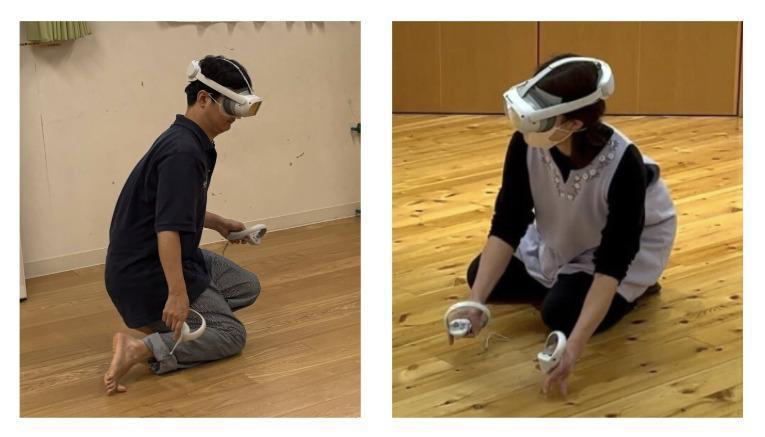
A caregiver wearing the HMD
Fig. 2 — A caregiver participating in the experiment wearing the HMD (PICO4 Enterprise).
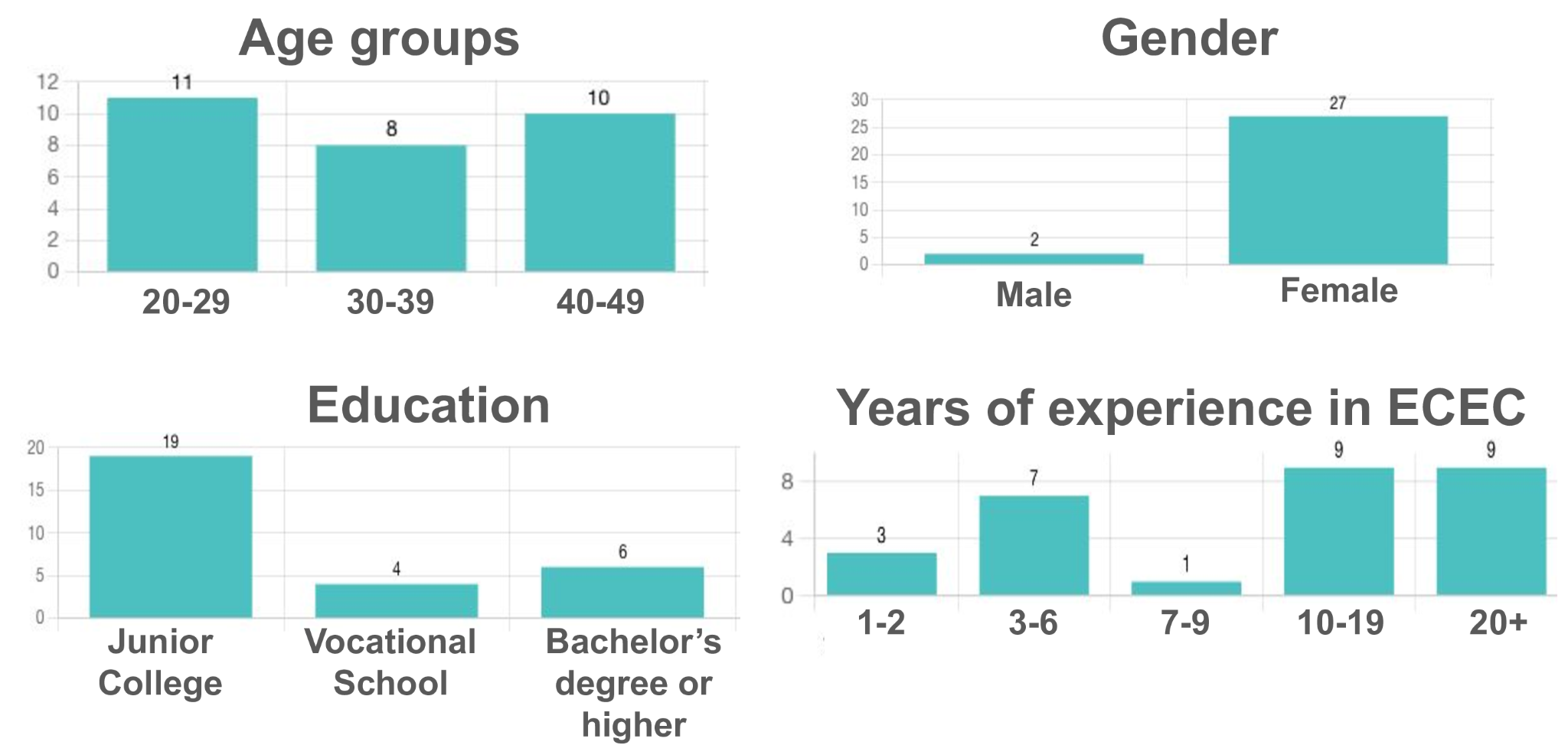
Participant profile
Fig. 3 — Basic profile of the 29 participants (age, gender, education, experience). More than half have 10+ years of experience.
03 · Results

RQ1 · Can individual differences be captured?

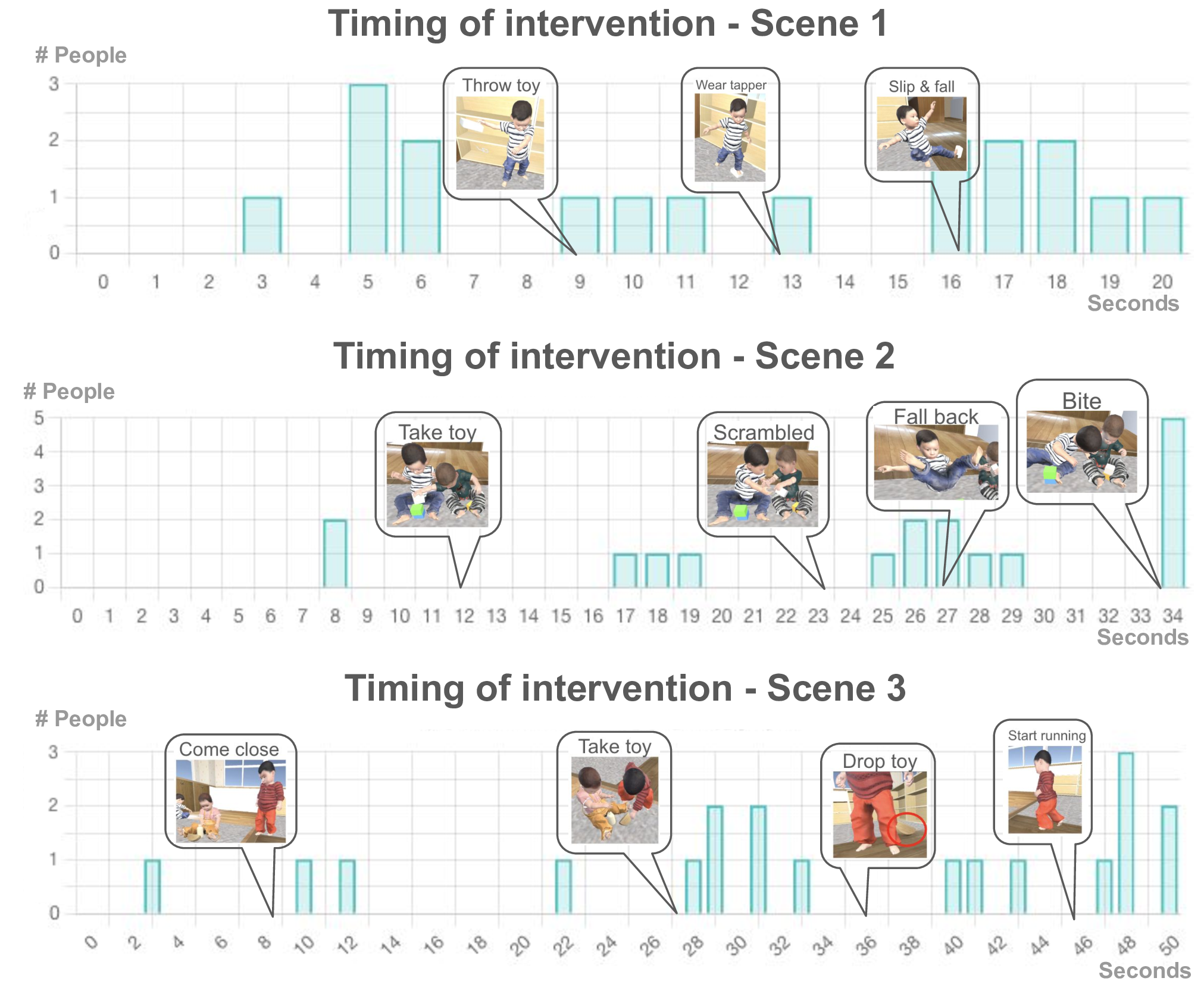
Intervention timing was widely distributed in every scene, confirming substantial individual differences, with clusters around specific scene phases. Timing in Scenes 2 and 3 correlated strongly (r = 0.75), while Scene 1 (a single child, no social cues) showed a different response pattern — suggesting behavioral indices may be unstable without social cues.

RQ2 · What is associated with timing?

Multiple regression associated later intervention with (1) lower workplace-relationship stress, (2) the belief in children's self-resolution (SCI: Facilitation), and (3) higher initiative (AS: Initiative). Conversely, caregivers with higher interpersonal stress tended to intervene earlier.
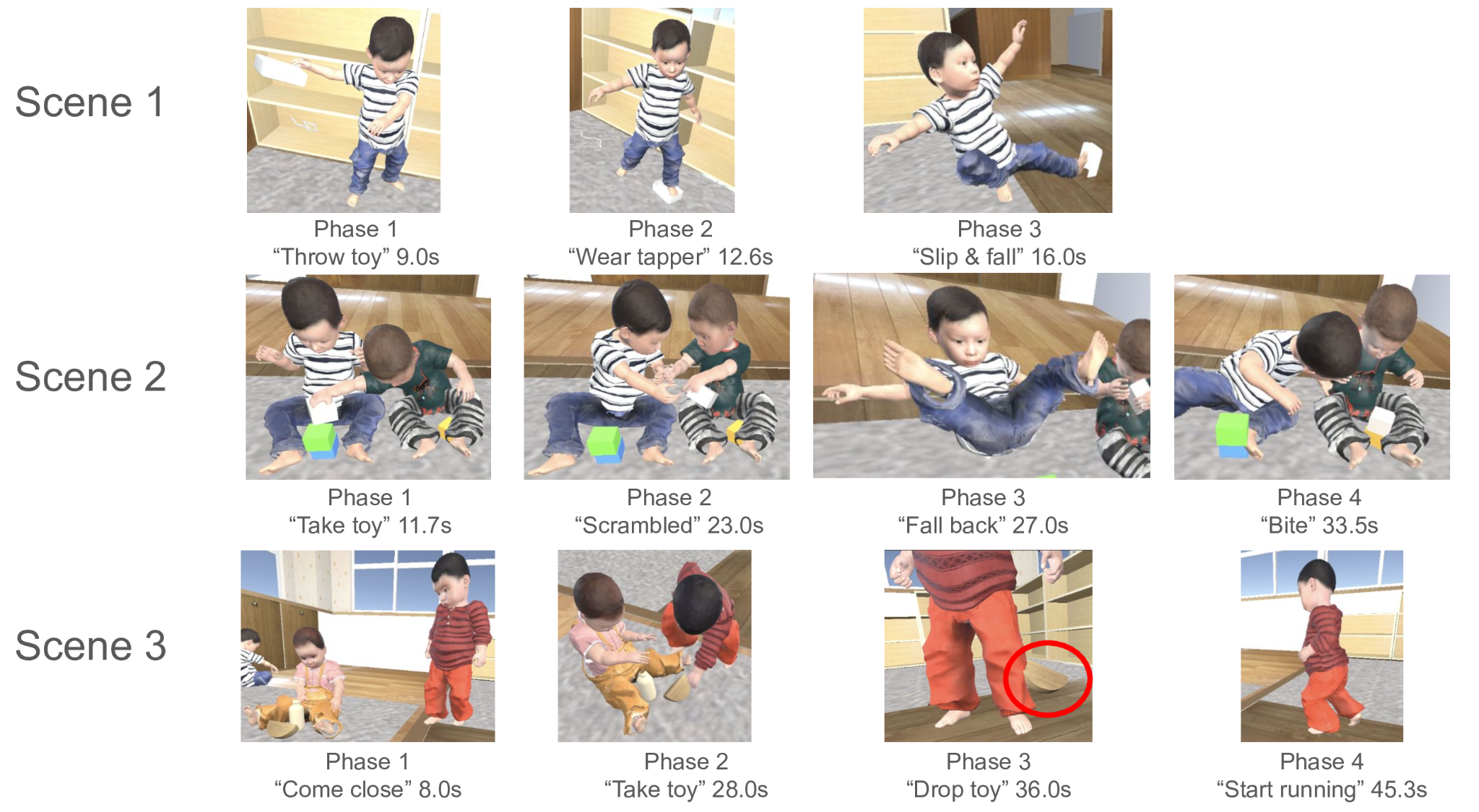
Key phases of the three scenes
Fig. 4 — Key phases of the three scenes, designed to escalate gradually and leave room for professional judgment.
Distribution of time to intervention
Fig. 5 — Distribution of time to intervention (x: seconds from scene start, y: count). Timing spreads widely, with clusters around scene phases.
KEY RESULT Main associations (correlation with intervention timing, Scenes 2 / 3)
FactorDirectionValue
SCI: Facilitation (belief in children's self-resolution)Later interventionr = 0.51 (p = 0.04) / 0.56 (p = 0.01)
AS: InitiativeLater interventionr = 0.72 (p < 0.01) / 0.65 (p < 0.01)
NTSS: Workplace-relationship stressEarlier interventionr = −0.45 (p = 0.07) / −0.50 (p = 0.03)
NTSS: Lack-of-time stressEarlier interventionr = −0.41 (p = 0.10) / −0.48 (p = 0.04)
SCI: Facilitation × head rotation speed (visual exploration)Positive correlationr = 0.43 (p = 0.02)
The actual questionnaire items behind each factor
SCI: Facilitation (4 items, 4-point)"When intervening in an object dispute, the most important thing is to help the children solve the problem themselves." / "When intervening in a conflict caused by a child breaking a class rule, the most important thing is to help the children solve the problem themselves." / "To foster a sense of community and harmony in the group, it is more important to help children learn how to resolve conflicts than for the teacher to solve them on their behalf." / "When intervening in a conflict caused by a difference of opinion between children, the most important thing is to help the children solve the problem themselves."
AS: Initiative (2 items, 5-point)"Tends to act proactively." / "Can act immediately in critical situations."
NTSS: Workplace-relationship stress (5 items, 5-point)"Relationships among other teachers" / "My own relationships with other teachers" / "The attitudes and actions of surrounding teachers" / "Teachers being unable to unite emotionally" / "Disagreements with other teachers"
NTSS: Lack-of-time stress (2 items, 5-point)"Lack of private time" / "Difficulty taking days off"
Supplementary · Experience
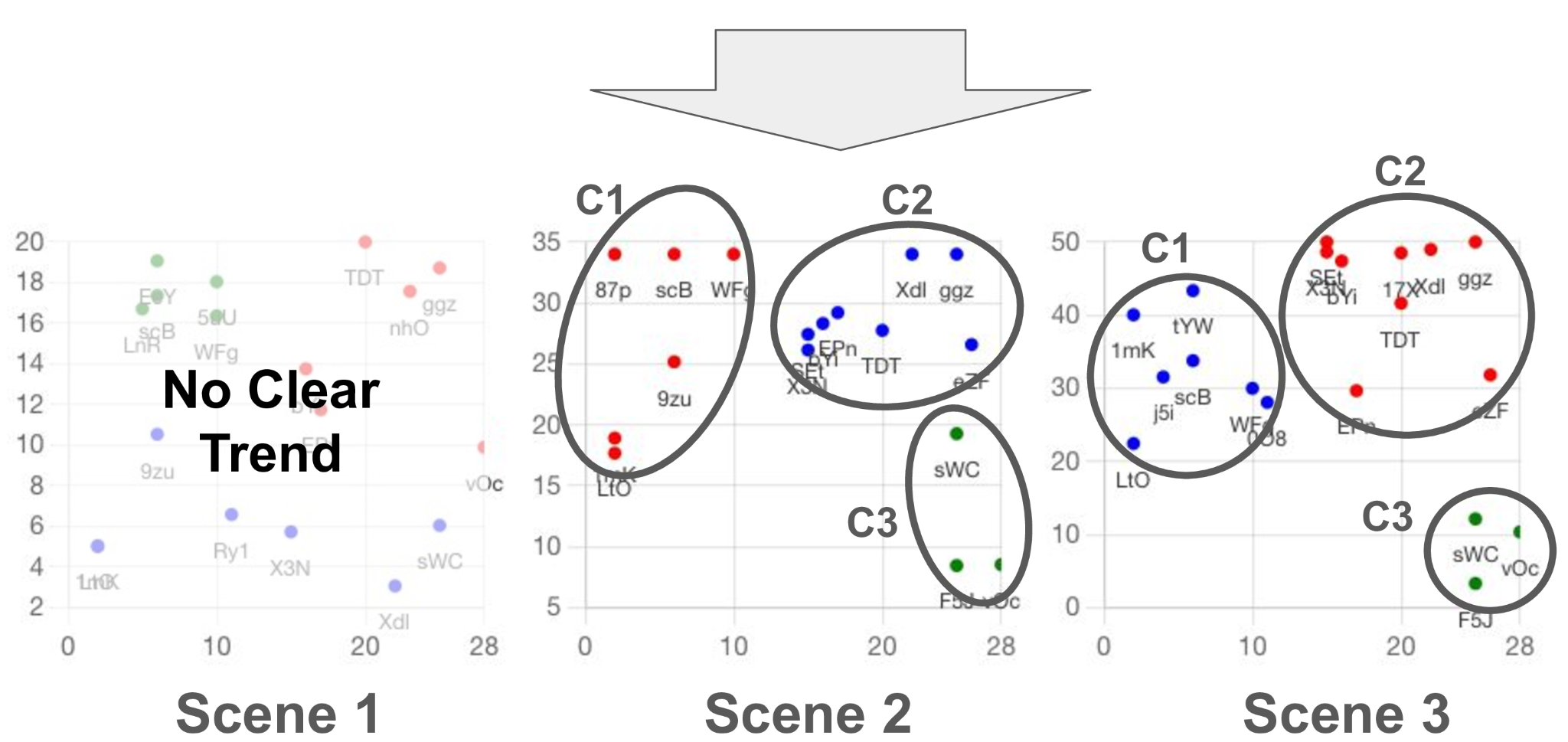
No consistent link was found between years of experience and later intervention. However, a small cluster (C3) of three veterans with 25+ years intervened markedly early and shared notably low Initiative and Sociability scores — suggesting a hypothesis that experience combined with interpersonal anxiety may tilt practice toward conflict-avoidant, "defensive" caregiving.
Cluster analysis of experience and intervention timing
Fig. 6 — k-means++ clustering of experience (x) and intervention timing (y). C3, lower right, is the veteran early-intervention cluster.
Supplementary · Reasons for intervening
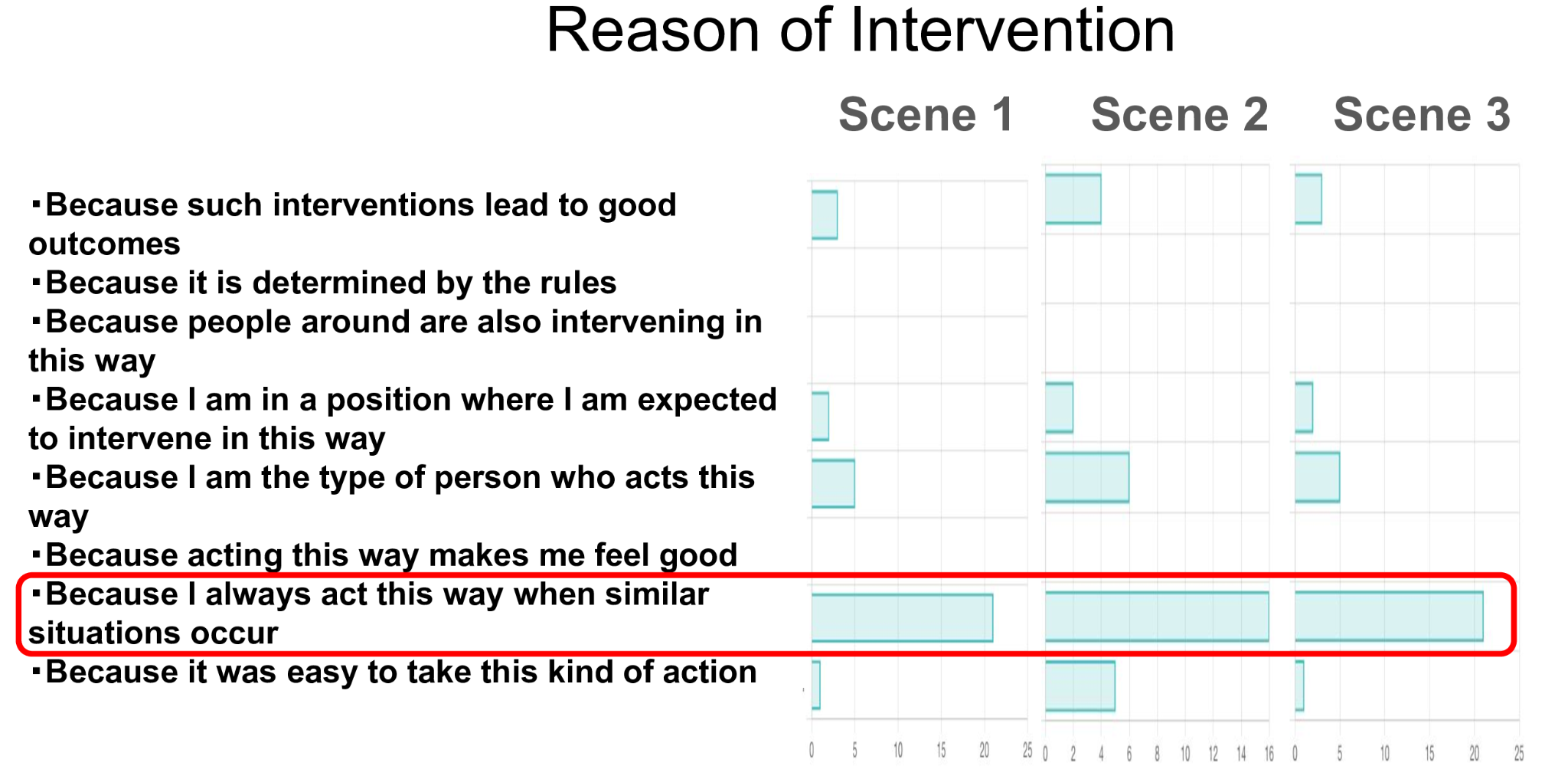
In the post-experiment questionnaire, "I always act this way in such situations" was by far the most common answer — most participants acted on habitual response patterns, consistent with the scenes reproducing everyday situations well.
Distribution of reasons for intervening
Fig. 7 — Reasons for intervening, based on Triandis' model of behavior. "I always act this way" (red frame) was the most common in every scene.
04 · Discussion & Outlook

Intervention timing is not merely a behavioral outcome but a process-level pedagogical construct that embeds the judgment and observation skills preceding action. The correlation between the belief in self-resolution and active visual exploration (head rotation) suggests that the professional discretion of "watching to decide whether to intervene" can be quantified from motion data — a path toward objectively assessing the practice of nurturing children's self-resolution valued in Japan's national childcare guidelines.

Outlook 1
VR for professional development
A tool for reflection and training where caregivers compare their quantified behavior (timing, observation intensity, movement) against quality indicators derived from childcare guidelines.
Outlook 2
Richer behavioral indices
Integrating gaze direction and detailed body position to deepen the understanding of professional skill profiles in infant care.
Outlook 3
Large-scale validation
Establishing the stability and generalizability of these trends with larger, more representative — ideally cross-cultural — samples.
Limitations
  • Small sample (N = 29) skewed toward veterans — all statistical results are exploratory, hypothesis-generating findings
  • Trade-off between standardization and ecological validity — expressionless CG children and a touch-only definition of intervention may differ from real judgment processes
  • Scene 1 (single child) was less reliable — intervention thresholds are unstable without social cues
  • Compensation differed by facility — exploratory analysis found no significant differences, but unmeasured bias may remain